
Publications
RECENT BOOKS
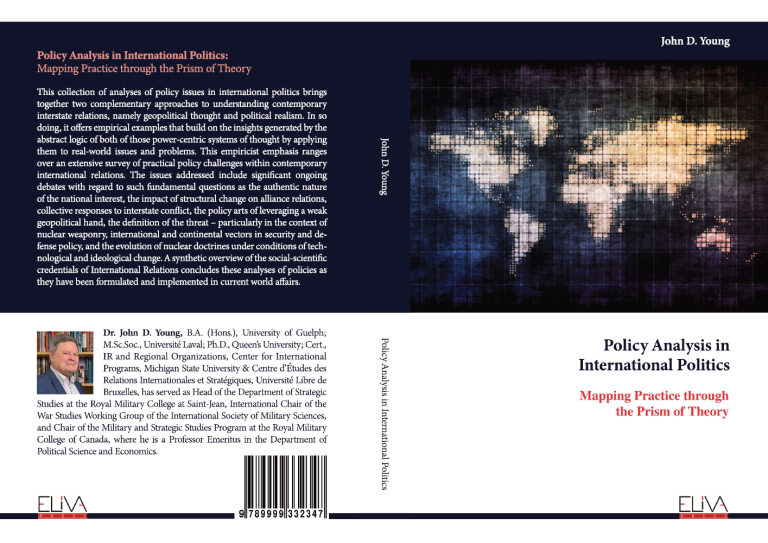
Policy Analysis in International Politics
Mapping Practice Through The Prism Of Theory
Chisinau, MD: Eliva Press, 2025. ISBN: 978-999933234-7
This collection of analyses of policy issues in international politics brings together two complementary approaches to understanding contemporary interstate relations, namely geopolitical thought and political realism. In so doing, it offers empirical examples that build on the insights generated by the abstract logic of both of those power-centric systems of thought by applying them to real-world issues and problems. This empiricist emphasis ranges over an extensive survey of practical policy challenges within contemporary international relations. The issues addressed include significant ongoing debates with regard to such fundamental questions as the authentic nature of the national interest, the impact of structural change on alliance relations, collective responses to interstate conflict, the policy arts of leveraging a weak geopolitical hand, the definition of the threat – particularly in the context of nuclear weaponry, international and continental vectors in security and defense policy, and the evolution of nuclear doctrines under conditions of technological and ideological change. A synthetic overview of the social-scientific credentials of International Relations concludes these analyses of policies as they have been formulated and implemented in current world affairs.
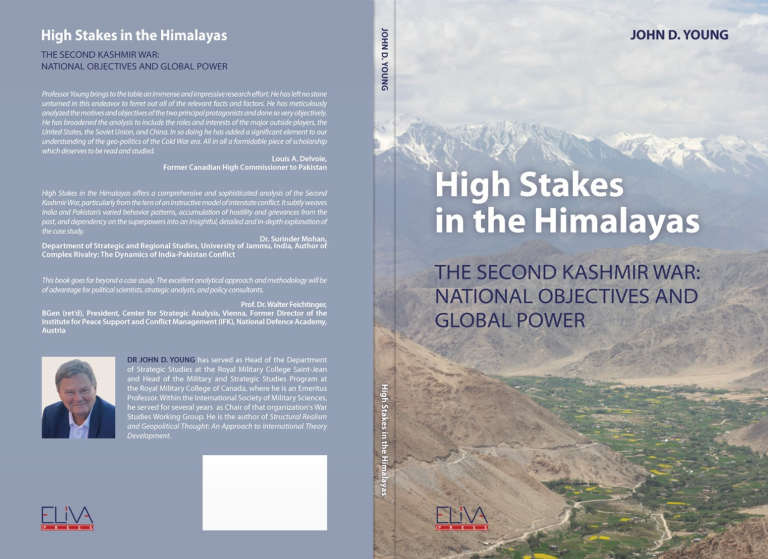
High Stakes in the Himalayas
The Second Kashmir War: National Objectives and Global Power
Chisinau, MD: Eliva Press, 2024. ISBN: 978-99993-1-732-0
The Kashmir Conflict has, for nearly eighty years now, mirrored both the interstate relations of India and Pakistan as well as the evolving structures of global political power. This account and analysis of the Second Kashmir War provides a thickly textured description of the interactions between South Asia’s enduring rivals during this tumultuous and, it can be credibly argued, decisive confrontation of collective wills. It does so by reporting both countries’ political leaders’ statements of their respective national objectives. Goal articulation is employed here as a means of analyzing the nature and scope of the issues at stake in this high-intensity trial by fire.
Juxtaposed with the complex interplay of competing national purposes, the impact of a secondary level of interstate relations, namely those engaging the polarizing powers of the times – the United States, the Soviet Union, and the People’s Republic of China, is integrated within the analytical framework so as to provide an accurate stocktaking of the war’s trajectory and outcomes. It is at these junctures- the interrelationships between Pakistan and India on the one hand, and their respective interactions with the three principal intervening powers, on the other, that the Second Kashmir War becomes readily intelligible in its significant dimensions. Lessons that can be applied in preventing, short-circuiting, and terminating the wars of the 21st century form a central element of this account and analysis.
PUBLICATIONS, CONFERENCE PAPERS & SUBJECT MATTER EXPERT PRESENTATIONS





Geopolitical Perspectives on the National Interest: The Case of the French Republic
Article Geopolitical Perspectives on the National Interest: The Case of...
Read MoreThe Unresolved Problem of Understanding Actor Purpose in International Relations Theory: The Concept of the National Interest
Article The Unresolved Problem of Understanding Actor Purpose in International...
Read MoreEnding Armed Hostilities in the Second Kashmir War: Evolving Actor Goals and External Influences
Article Ending Armed Hostilities in the Second Kashmir War: Evolving...
Read MoreNational Objectives and Global Power during the Second Kashmir War: The Crisis Period: 5 August – 22 September 1965
Article National Objectives and Global Power during the Second Kashmir...
Read MoreThe ‘Melancholy Paradox’ of Deterrence in the Nuclear Age, 1945-1965
Article The ‘Melancholy Paradox’ of Deterrence in the Nuclear Age,...
Read More(R)evolution in the Operational Environment: International Organisations and the Ukraine Crisis
Article (R)evolution in the Operational Environment: International Organisations and the...
Read MoreThe Conceptual Reworking of Deterrence Theory in American Nuclear Doctrine: The Emergence of a Countervailing Strategy
Article The Conceptual Reworking of Deterrence Theory in American Nuclear...
Read MoreThe Second Kashmir War: Synopsis of Dyadic and Polarization Events
Article The Second Kashmir War: Synopsis of Dyadic and Polarization...
Read MoreThe Historical Background of the 1965 Kashmir War: 1961-1964
Article The Historical Background of the 1965 Kashmir War: 1961-1964...
Read MoreThe Second Kashmir War : Polarization and Capabilities : 1961-1964
Article The Second Kashmir War : Polarization and Capabilities :...
Read More
“Morally the wielder of power appears to cause the event, physically it is those who submit to the power. But as the moral activity is inconceivable without the physical, the cause of the event is neither in the one nor in the other, but in the union of the two.”
Tolstoy